

The software delivery model is changing. Is your team ready to change with it?
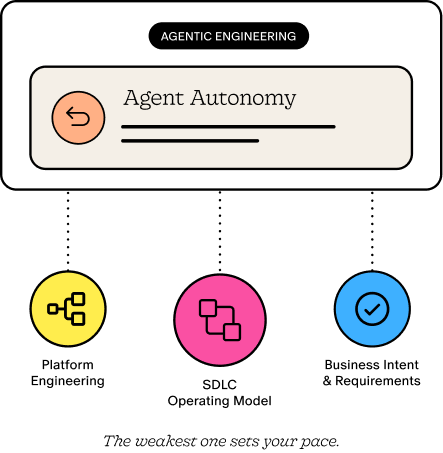
More AI tools won't get you to agentic engineering. Getting there depends on three things maturing together: your platform, your delivery model, and the way your business defines what to build. We'll help you find your starting point and pull the whole system forward.
Copilots are easy. Operating models are hard.
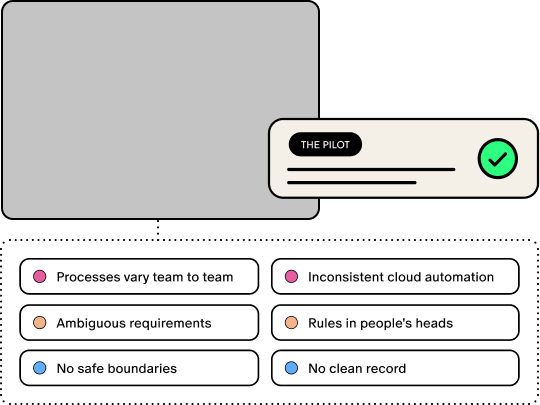
Most teams have added AI to individual workflows and seen a real bump in speed. Then the pilots stall. The reason usually isn't the AI. It's everything around it.
Engineering processes vary team to team. Cloud automation is inconsistent. Requirements are too ambiguous for an agent to act on. Business rules live in people's heads. Agents have no safe boundaries to execute inside, and there's no clean record of what they did. So the promising pilot never becomes the way you actually ship software.
Closing that gap is the work. That's where we come in.
Three pillars, and they have to move together.
Agent autonomy rests on three foundations. Push one ahead of the others and you get expensive, unreliable results. Your real maturity is set by whichever pillar is furthest behind.
 PILLAR 1
Platform Engineering
The environment where your team and your agents build, test, deploy, and operate. Cloud, infrastructure as code, CI/CD, golden paths, security, observability, and the identity and controls that let an agent execute safely.
 PILLAR 2
SDLC Operating Model
How work moves from an idea to production. What artifact drives development, how testing gets defined, how changes are approved, and where humans and agents split the work.
 PILLAR 3
Business Intent & Requirements
How you define what to build and why. Outcomes, business rules, constraints, compliance obligations, and the acceptance conditions that tell an agent when it's done.
Four levels, one honest question: where are you really?
Maturity isn't your best demo or your most advanced squad. It's how your organization ships by default.
- Level 1
AI-Assisted Development
AI helps individual developers write code, tests, and docs. People still direct the lifecycle. Faster tasks, same process.
- Level 2
Agent-Enabled Workflows
Agents run bounded, repeatable pieces of the lifecycle under human supervision. Structured requirements and golden paths make that possible.
- Level 3
Agentic Delivery
Agents plan, implement, test, and deliver changes from a governed specification. Humans govern boundaries and approve higher-risk moves instead of directing every step.
- Level 4
Autonomous Software Engineering
Agents continuously improve software within explicit policy and risk limits. People own strategy, risk appetite, and judgment.
The stall points are predictable.
When the pillars fall out of step, the failure mode is easy to name:
Strong AI, weak governance
Agents operate without the identity, authorization, or recovery controls to act safely.
Strong platform, weak SDLC
Agents can execute, but ambiguous requirements produce inconsistent results.
Strong SDLC, weak platform
Agents know what to build and can't build it safely or consistently.
Heading
You efficiently build the wrong thing because the business direction isn't clear.
01
Asses
Establish your current baseline with a focused 20-question self-assessment across all three pillars. Find your weakest pillar and the teams ready for a pilot.

02
Validate
Back up the self-assessment with evidence: platform architecture, SDLC artifacts, and business-intent documentation.

03
Prioritize
Turn the gaps into a roadmap, sequenced by maturity dependency, risk reduction, and business value.
04
Pilot
Prove agentic delivery in a controlled, high-value workflow with clear inputs and measurable results.
05
Scale
Extend what works across more teams, applications, and environments, with governance that grows alongside autonomy.
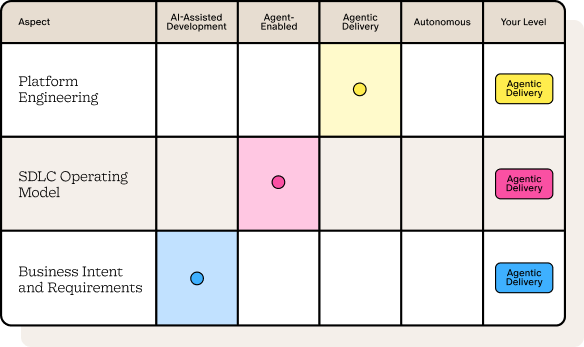
Maturity progression by pillar
Delivery
Software Engineering
Platform Engineering
SDLC Operating Model
Business Intent
What our partners say
"Tensure is the best agency I've ever worked with, period. I often find myself choosing between partners that are great at the work (but lack leadership & creativity) and agencies who are proactive & inventive but don't enjoy getting into the nitty gritty. Tensure, without ego, flexes between the two areas seamlessly based on whatever I need."

Tensure provided us with smooth onboarding to run our applications in GKE and gave us patterns that we can use to scale out as needed.

“Tensure’s execution exceeded expectations. Their expertise and ability to deliver a seamless transition gave us confidence in both the technology and the partnership. They helped us lay a solid foundation for future scalability within Spanner.”

“Working with the Tensure team was nothing short of remarkable. The odds were stacked against us when they joined. A highly complex project that spanned across numerous stakeholders and privacy regulations. Their expertise, adaptability and dedication turned the once improbable project to a resounding success.”


Not sure where you stand?
Take our 20-question self-assessment across Platform Engineering, SDLC, and Business Intent. You'll get a maturity level for each pillar and a clear read on which one to strengthen first.


Let's find your starting point
Agentic engineering isn't a tool you buy. It's a capability you build, and it's easier with a partner who's done it before. Bring us where you're stuck. We'll help you pull it into shape.